What is an AI Agent Memory System?
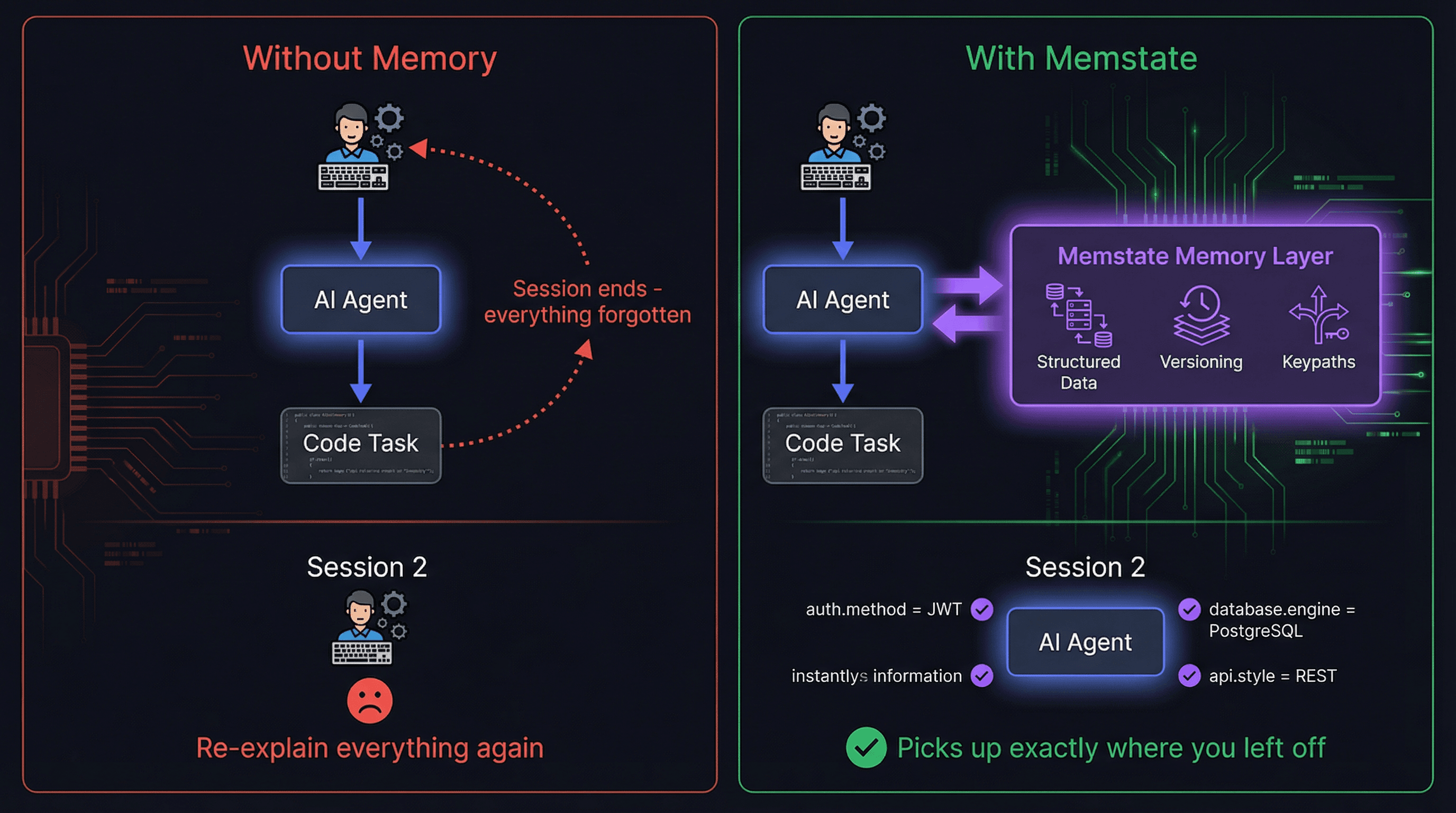
If you use AI coding tools like Cursor, Windsurf, or Cline, you know the frustration of having to re-explain your project context every single session. An AI agent memory system solves this by giving your tools persistent, long-term recall.
The "Groundhog Day" Problem in AI Coding
Modern Large Language Models (LLMs) are incredibly smart, but they suffer from severe amnesia. By design, they are stateless. When you start a new chat session in your IDE, the AI has absolutely zero knowledge of what you did yesterday.
This leads to a massive waste of time and tokens. You find yourself pasting the same architecture guidelines, explaining the same database schema, and correcting the same naming convention mistakes over and over again.
How an AI Memory System Works
An AI agent memory system acts as an external brain for your LLM. It sits outside the immediate context window and stores facts, decisions, and preferences persistently.
Thanks to the Model Context Protocol (MCP)—an open standard for connecting AI models to data sources—integrating memory is now seamless. Here is the typical lifecycle:
Discovery (Before the task)
When you ask an agent to build a new feature, it first queries the memory system via MCP to retrieve relevant context. It learns that you use PostgreSQL, Tailwind CSS, and specific authentication methods before writing a single line of code.
Execution (During the task)
The agent completes your request faster and more accurately because it already knows the "rules" of your codebase. It doesn't hallucinate incompatible libraries.
Ingestion (After the task)
Once the work is done, the agent sends a summary of new decisions back to the memory system. The memory system extracts the facts, updates its records, and stores them for the next session.
Why You Need Dedicated Memory (Not Just Big Context)
A common misconception is that massive context windows (like Claude's 200k tokens or Gemini's 1M+ tokens) solve the memory problem. You can just dump your entire codebase into the prompt, right?
While helpful, massive context has severe limitations:
- Cost: Passing 100k tokens of context on every single prompt gets incredibly expensive, very fast.
- Latency: Processing massive context windows takes time, slowing down the agent's response speed.
- Attention degradation: LLMs suffer from "lost in the middle" syndrome. The more noise you feed them, the more likely they are to miss crucial instructions buried in the text.
A dedicated memory system like Memstate AI solves this by only feeding the agent the exact, relevant facts it needs for the current task, keeping prompts lean, fast, and cheap.
Related Guides
Ready to give your agent memory?
Memstate AI integrates with Cursor, Windsurf, Cline, and more via MCP in under 2 minutes.